Somewhere in the last year, “programmatic SEO” went from a niche technical term to a phrase practically every growth marketer feels obligated to have an opinion about. You’ve probably heard the success stories: a company goes from a handful of pages to hundreds of thousands, organic traffic climbs into the millions, and suddenly everyone in your Slack channel is asking why you haven’t tried it yet.
But here’s what rarely gets said in those success stories: for every company that scaled brilliantly with programmatic SEO, there’s another that spent real money building thousands of pages that never ranked, never converted, and quietly got buried by a search engine algorithm update. The technology and the strategy are real. The universal applicability that vendors imply is not.
If you’re trying to figure out whether programmatic SEO services are worth investing in for your business, or whether you’re about to fund an expensive mistake, this is the conversation you actually need to have before signing a contract.
What Programmatic SEO Actually Is, Stripped of the Hype
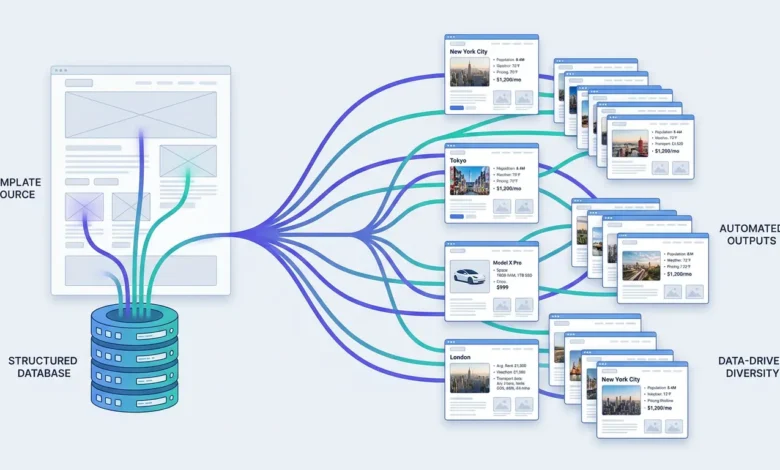
Let’s start with a clear definition, because a lot of confusion in this space comes from vague marketing language rather than a genuine misunderstanding of the mechanics. Programmatic SEO is a scalable strategy that uses automation, structured data, and page templates to generate large numbers of optimized landing pages targeting specific search queries, rather than creating pages manually one at a time. Instead of a writer producing a single article about, say, “best running shoes for flat feet,” a programmatic system might generate a thousand pages, each targeting a slightly different combination of shoe type, foot condition, and use case, all pulled from a structured dataset and inserted into a consistent template.
Done well, this isn’t a shortcut or a trick. It’s a legitimate way of matching content to the enormous volume of highly specific, lower-competition searches that traditional content strategies simply don’t have the bandwidth to cover. Done poorly, it’s a machine for producing thin, repetitive pages that offer no real value to anyone who lands on them, which search engines have gotten increasingly good at identifying and penalizing.
That distinction, between programmatic done well and programmatic done carelessly, is really the entire question this article is trying to help you answer.
The Businesses Where This Investment Tends to Pay Off
There’s a specific profile of company where programmatic SEO services consistently deliver strong returns, and it comes down to one core ingredient: structured data at scale. If your business already possesses a large, genuinely useful dataset, a product catalog, a directory of service providers, a database of locations, a list of software integrations, programmatic SEO isn’t manufacturing content out of nothing. It’s simply exposing information you already have in a format search engines and searchers can find.
This is precisely why programmatic SEO tends to be associated with SaaS companies, marketplaces, directories, fintech brands, and AI startups looking to capture long-tail search demand at scale, and it’s not a coincidence. Marketplaces have listings. SaaS companies have integrations and use cases. Directories have, by definition, exactly the kind of structured entries that translate cleanly into individual pages. In these situations, a programmatic approach isn’t creating artificial content; it’s unlocking latent value that was already sitting in a database, unseen by search engines because it had never been surfaced as indexable, well-structured web pages.
If this describes your business, the math tends to work strongly in your favor. The marginal cost of generating another thousand pages from existing data is low, while the cumulative traffic captured across thousands of long-tail searches can meaningfully exceed what a handful of hand-written articles ever could.
Where the Investment Becomes a Liability Instead of an Asset
Now for the harder truth, the one a lot of agencies selling programmatic SEO services won’t lead with. If your business doesn’t have that underlying structured dataset, or if your team lacks the discipline to maintain quality across scale, programmatic SEO tends to become an expensive way to damage your site’s credibility rather than build it.
Here’s the mechanism worth understanding clearly. Search engines evaluate not just individual pages but the overall quality signal of a domain. When a site suddenly floods itself with thousands of near-identical, thin pages, generic templates with minimal unique value swapped in per page, it doesn’t just fail to rank those specific pages. It can drag down the perceived quality of the entire domain, making it harder for your genuinely strong content to perform as well as it should have on its own.
This is the trap that catches so many companies who see a competitor’s programmatic success and assume the same playbook will work for them. They don’t have the data depth to support genuine differentiation between pages, so they end up with a templated page that says essentially the same thing a thousand different ways with a keyword swapped in each time. Search engines have become considerably better at detecting this pattern, and the consequences can take months to recover from, all while the invoice for the agency that built it keeps arriving.
The Quality Question Nobody Wants to Ask Out Loud
Even among companies with legitimate structured data, there’s a spectrum of execution quality that determines whether the investment pays off. The uncomfortable question worth asking any programmatic SEO service before hiring them is this: what happens to page quality at scale?
A strong programmatic system doesn’t just swap a variable into a template. It varies structure, incorporates genuinely different supporting information per page, and includes quality control processes, sometimes automated, sometimes involving human review, that catch and either improve or suppress low-value pages before they go live. A weak system publishes everything the template generates, indiscriminately, and hopes volume compensates for thinness. It rarely does, not sustainably.
When evaluating a potential agency partner, ask specifically how they handle content differentiation across pages that share a template, what their process looks like for identifying and pruning underperforming pages, and how they think about balancing automation with genuine editorial judgment. Vague answers about “AI-powered content generation” without a clear quality framework underneath should be treated as a warning sign, not a selling point.
The Cost Conversation That Determines Real ROI
Programmatic SEO services aren’t cheap, and the pricing structure matters more than most companies initially appreciate. Some agencies charge based on page volume, which can create a subtle but important misalignment of incentives: an agency paid per page has some motivation to maximize output rather than optimize for genuine performance per page.
The more useful way to evaluate cost is against realized traffic and conversion outcomes per cohort of pages, not raw volume produced. A batch of five hundred pages that converts meaningfully and holds its rankings is a far better investment than five thousand pages that spike briefly in a crawl report and then quietly fade from search results within a few months. Before committing budget, ask what reporting cadence and performance benchmarks the agency uses, and make sure those benchmarks are tied to outcomes you actually care about, qualified traffic, signups, or revenue, rather than vanity metrics like total indexed pages.
A Practical Way to Decide If You’re Ready
If you’re still uncertain whether programmatic SEO services make sense for your specific situation, run through this honestly before spending anything. Do you have a dataset large and specific enough to support genuine differentiation across hundreds or thousands of pages, not just a superficial keyword swap? Does your team, or the agency you’re evaluating, have a clear, demonstrable quality control process rather than a vague promise of “AI at scale”? And critically, does your existing site have a reasonably solid technical and content foundation already, since programmatic strategies tend to amplify whatever quality signal a domain already has, for better or worse?
If you answered yes to all three, programmatic SEO is very likely worth the investment, and probably overdue. If you answered no to any of them, particularly the data question, it’s worth pausing before committing budget, because the failure mode here isn’t a mediocre return. It’s active harm to a site’s search visibility that can take considerably longer to repair than it took to create.
The Nuance Most Vendors Won’t Tell You
It’s also worth acknowledging that this isn’t strictly binary. Some companies benefit from a hybrid approach: a smaller, carefully executed programmatic initiative targeting a specific, well-defined dataset, rather than an all-or-nothing scale play across the entire site. Starting with a contained pilot, a few hundred pages built around one clearly structured data segment, lets you evaluate real performance and search engine response before expanding further. This measured approach costs less upfront, reduces the risk of a quality penalty affecting your whole domain, and gives you actual performance data to negotiate more intelligently with any agency proposing a larger engagement.
The Decision That Actually Matters Here
The real question isn’t whether programmatic SEO works. It clearly does, for the right kind of business, executed by people who understand the difference between scale and substance. The question that matters is whether your business has the structural ingredients, genuine data depth, quality discipline, and a foundation worth amplifying, to make that scale meaningful rather than hollow.
Before you sign a contract with any agency promising thousands of pages and explosive traffic growth, ask them to show you exactly how they’d avoid becoming just another cautionary tale about programmatic SEO gone wrong. The agencies confident in their quality process will welcome that question. The ones who can’t answer it clearly have already told you everything you need to know.


